Which Fence Types Hold Up Best to Florida Wind
Wind load, panel spacing and what actually fails first in a storm. How fence design affects survival.
No fence is storm-proof. The useful question is how a particular design handles pressure, where that pressure travels, and whether the posts and gates were built for the load. Material matters, but openness and construction matter just as much.
A solid fence acts like a sail
Wind moving toward a solid privacy fence cannot pass straight through it. Pressure builds across the face and transfers through the rails into the posts. The taller and more continuous the surface, the more leverage reaches the ground. That does not make privacy fencing a bad choice. It means its post size, depth, spacing and footings cannot be treated like those of an open fence.
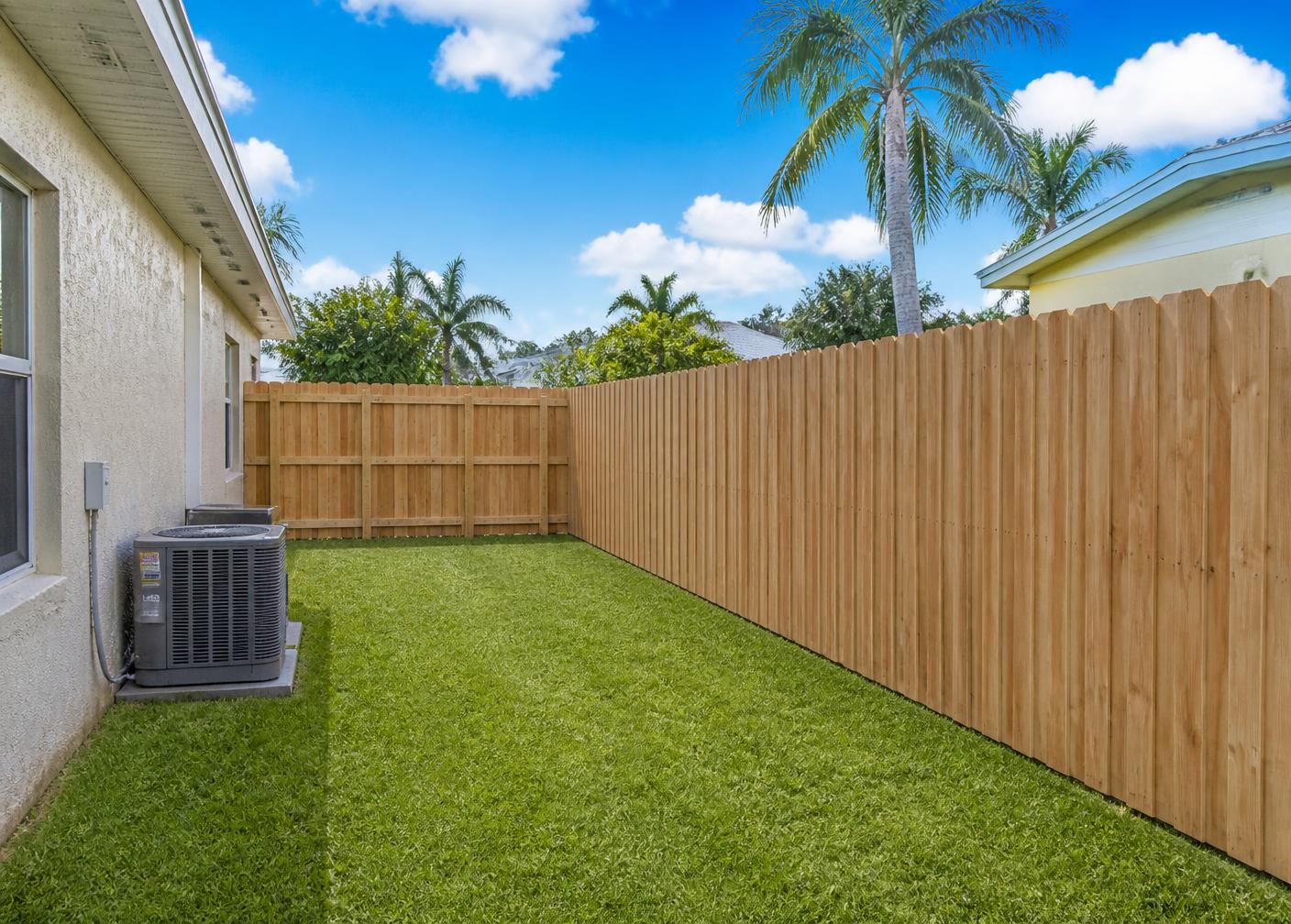
Vinyl and wood privacy fences can both perform well when the whole system is designed together. Problems begin when large solid panels are attached to lightly set posts, when posts are too far apart, or when water has already weakened the ground around them.
Open designs reduce pressure
Chain link allows most wind to move through the fabric, so it presents far less surface area. Aluminum pickets do the same. Both still depend on sound posts and connections, but they do not catch the same broad load as a solid wall.
Wood shadowbox and spaced-board designs sit between open pickets and full privacy. Their overlapping or separated boards interrupt the view while creating paths for some air to pass. For a homeowner who wants privacy without one uninterrupted surface, that can be a practical compromise.
Panel-built and stick-built failures
Prefabricated panels behave as connected sections. Under enough pressure, a panel may separate from a rail, a bracket may pull loose, or the load may reach the posts. Stick-built fencing is assembled board by board on site, so damage may stay limited to individual pickets or rails. Neither method is automatically stronger. Fasteners, rail attachment, post spacing and the quality of the installation decide how the assembly responds.
Sometimes a replaceable panel or picket failing is better than the entire post line moving. The visible damage may look dramatic while the expensive underground structure remains sound. That is why a post-by-post inspection matters after a storm.
What usually fails first
The critical point is often at ground level. Moisture, decay, corrosion, repeated movement and changing soil conditions all meet there. A post can look fine above grade while being weak where it enters the ground. When wind loads the fence, that hidden weak point becomes a hinge.
Gates are another vulnerable area because they are heavy moving sections supported from one side. A gate left unlatched can swing, slam and multiply the force on its hinge post. Loose hinges, a dragging bottom edge or a latch that no longer lines up are signs that the assembly needs attention before storm season.
What to check before a storm
Walk both sides of the fence and push each post near shoulder height. Movement at the base deserves a closer look. Check for soil washed away from footings, wood softness at grade, cracked vinyl posts, loose brackets, missing fasteners and rails pulling away from posts.
Close and latch every gate. Confirm drop rods seat securely on double gates and remove loose objects that could strike the fence. Trim dead limbs that hang directly over the line when it is safe to do so. The best storm preparation is not a last-minute brace; it is finding ordinary wear before wind turns it into a full section failure.
Thinking about a new fence?
Vinyl, wood, aluminum, chain link and farm fencing across Ocala and Marion County — free written estimates and a 5-year workmanship guarantee.
LIMITED-TIME OFFER: FREE GATE WITH YOUR NEW FENCE INSTALL